
Modern life is rubbish, as is modern thinking. Such has been the charge going back at least to arch-reactionary Joseph De Maistre’s accusation that French Revolutionaries, his contemporary moderns, were “Satanic” and their philosophies a destructive force. For centuries modernity has not simply been a historical phase. Much less has it been a mere term for the present. Instead modernity has been the subject of an often contentious discourse, which has quite often bubbled outward to influence more epic clashes in practice. Right wingers from De Maistre through Strauss, Schmitt, and Heidegger proclaimed the nihilistic fallenness of the modern world and therefore rejected it. Defenders of modernity, from liberals to socialists to liberal socialists, may acknowledge its flaws or dismiss them. But they will uniformly insist we are not going back.
As such critical proclamations suggest, our cultural and political moment is one where critique and contempt for modernity and its doctrines runs rampant. There are few left radicals out there who may still see this as an opportunity. But by and large it has been the right which has benefited from this anomie, arguing that paradigmatically modern doctrines like liberalism, feminism, and socialism have run their course. It is time for a return to the old – which as it turns out will require doing a lot that is new.
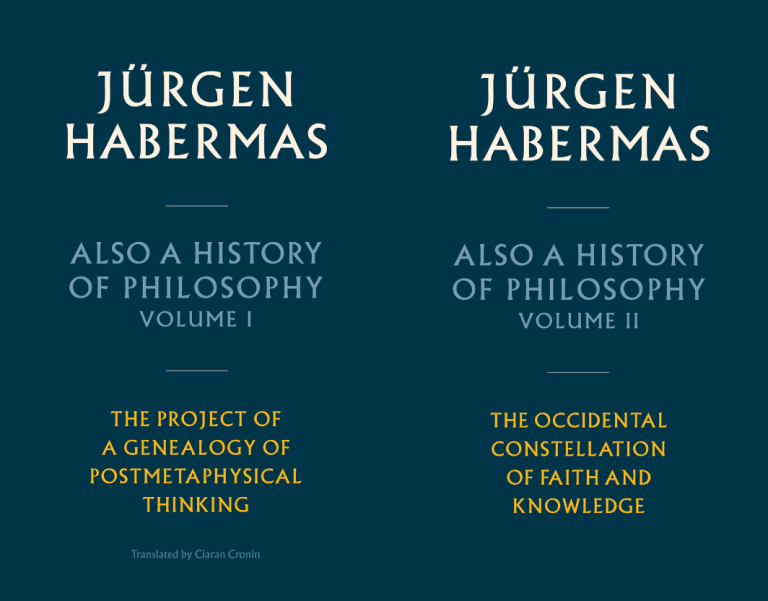
Standing beyond this reactionary march, yelling “stop!”, is Jürgen Habermas. At 95 one could be forgiven for assuming the eminent German philosopher and social theorist has long settled into retirement. He’d have certainly deserved it after an auspicious career that spans the better part of a century, producing classic books such as The Theory of Communicative Action, which led scholars to mention Habermas in the same breath as Nietzsche, Derrida, Foucault and Strauss. Prolific as ever, Habermas has recently produced his largest and most ambitious work yet: Also a History of Philosophy. At three volumes, only two of which are translated into English so far, it’s an opus that demonstrates a transdisciplinary mastery of what feels like the entire sweep of Western humanities and social sciences. In lesser hands such a project would inevitably become a mess, the literary equivalent of Francis Ford Coppola’s Megalopolis.
But the quietly determined unity of Habermas’ purpose makes the first two volumes feel like vital reading, despite his signature lumbering prose and endless asides. Modernity, argues Habermas, is not an experiment to be rejected, but an ideal yet to be truly realized.
Also a History of Philosophy has a misleading title since it is most definitely not a conventional history of philosophy. It includes long segues into political and social history, anthropology, sociology, and a leap forward from antiquarian to modern science, which could constitute a book in its own right. Habermas is not simply chronicling the development of his academic discipline. He is unapologetically both a participant and a partisan in a much grander story. He reads his predecessors to that track their evolution toward the “postmetaphysical” thinking of modernity and affirms this as a positive development for both philosophy and humanity. It’s a Hegelian Whig history that has unexpectedly come back into fashion through the writings of authors like Robert Brandom, Charles Taylor, and Habermas himself. Many of us assumed the audacity to write such a history had disappeared when modernity gave way to post-modernity. But perhaps the hunger for such an affirmation of our long course of maturation has never dimmed.
There are also less scholarly motivations behind the work. As far back as The Philosophical Discourse of Modernity, Habermas defended the incomplete project of modernization from conservative enemies on the right and post-modern skeptics on the left. He acknowledged that this was an enormous challenge in no small part because of the self-conscious newness of modernity and the fact that for many that was the appeal. Defenders of modernity saw themselves initiating a new age-beginning the world over again, as arch-revolutionary Thomas Paine put it. As it turns out things are more complex, and modernity is very much a new beginning that emerged from the fertile soil of pre-modernity. Habermas is very sympathetic to this goal since much needed to be remade anew to put human knowledge and society on a rational basis. But it also meant that by trying to radically break itself off from the pre-modern past, modernity risked becoming like the proverbial man resting on a high branch he is diligently sawing off the tree. In The Philosophical Discourse a younger Habermas proclaims “modernity can and will no longer borrow the criteria by which it takes its orientation from the models supplied by another epoch; it has to create its normativity out of itself. Modernity sees itself cast back upon itself without the possibility of escape. This explains the sensitiveness of its self-understanding, the dynamism of the attempt, carried forward incessantly down to our time, to “pin itself down.”
The bootstrapping problem of modern normativity has always left it vulnerable to the accusation that it will or has failed, leaving us with no shared, rational, belief system at all. And this opens the door to nihilism of many different flavors – from the cynical resignation of the last man to the artificial mythmaking of the fascist stormtrooper with whom Habermas had formative and terrifying experience. Or, says the siren call of the right, we can return to the older constellations of thinking: Greek natural law, Christian nationalism accompanied by scholasticism, a neopaganistic world of Caesars without the soul of Christ exercising dominion over Greenland and Panama.
Not coincidentally Habermas opens Volume I of Also a History of Philosophy by briefly discussing the accusations of rightwing critics of modernity: Carl Schmitt, Leo Strauss, Martin Heidegger and Karl Lowith. Each in their own way favors some kind of return that will mean rejecting the deadening vapid egalitarian doctrines like liberalism and socialism, those doctrines which are “metaphysically the same” as Heidegger put it. Habermas takes this challenge seriously and wants to offer a gigantic defense of modernity and post-metaphysical thinking, alongside the politics and culture they complement.
In The Philosophical Discourse of Modernity Habermas seemed convinced modernity needed to establish itself on its own merits without looking back. But today, Habermas is less emphatic about the need for modernity to develop normativity only from its own resources. This is a sensible move, for both philosophical and political reasons. Philosophically, the idea that modernity radically broke with the past seemed both implausible and ahistorical. Dare I say, undialectical? But the more political motivation seems to be showing that modernity isn’t a fall from or rejection of the past. Instead it carries what is best in all that came before but rationalizes it by heightening the past’s core insights. The story of Western philosophy is one of bumpy progress.
Also a History of Philosophy chronicles the deepening rationality of modern thought. Habermas’s story begins with mythic ways of apprehending the world. Prehistoric human beings depicted the world full of very personal, but divine, powers who could be swayed and bargained with like all mortal individuals. He then discusses with praise the great “axial” world religions of Buddhism, Daoism, and Judaism for pointing the human intellect upwards toward a transcendent and eternal realm – though access to it was still mediated by symbol and myth. Later the Greek philosophers such as Aristotle and Plato largely began to apprehend the eternal world directly through reason. While they were aware of the limitations of human knowledge, it was Christianity that made a decisive step forward toward modernity by stressing human finitude through the gap that existed between humanity and God which reason could never fully overcome. This redirected philosophical attention to the inward conscious mind and soul of each individual – a crucial move toward both the Enlightenment philosophy of the subject and liberal individualism. As Habermas puts it late in Also a History of Philosophy’s second volume, socialism itself would emerge as a successor to “the political Enlightenment” through a “radicalization of bourgeois (aka liberal) thought” which would now seek “transcendence from within.” Socialism, liberalism, and democracy are mature doctrines carrying on one Western project of bringing about a just world, no longer through transcendence in a deferred next life but through establishing justice for all in this world through the application of human reason.
At the level of metaphysics and post-metaphysics Habermas’ story is very convincing. It undercuts the bifurcations upon which critics of modernity often lie. The mirror image of the reactionary’s one-sided condemnation of modernity as a great leap down from the past is Stephen Pinker’s one-sided proclamation of modernity as a great leap up. By showing in exhaustive (and sometimes exhausting) detail how modernity was birthed out of antiquity and so carries its genetic stamp, Habermas quietly but radically subverts the reactionary who wants to describe it as an aberrational cataclysm. Moreover by describing modernity as not only developing out of antiquity but improving on it, Habermas shows why modernity should be accepted by critics. If it is the case that modern thought is more rational, more just – a kind of ethical growth as Charles Taylor would put it in Cosmic Connections – and simply more true, then it must be accepted and defended by any who remain sincerely committed to Plato, Aristotle and Augustine’s love of truth, beauty, and wisdom. As Habermas puts it in Volume One:
…The authors of the narrative decline of modernity [fail] to seriously entertain some important questions: might the philosophical pioneers of the seventeenth and eighteenth century not have had good reasons to abandon the Greek or the Christian concept of the logos or of the divine reason and to take the mathematical natural sciences or jurisprudence as their model instead? Did they not have good reasons for replacing the ontological questions with an epistemological one? Did they have good reasons to be interested in the conception of self-preservation than in that of being? Did they have good grounds for differentiating the concept of reason in such a way that different categories of questions – empirical and theoretical, moral and legal, ethical, aesthetic and expressive – no longer had to be answered ‘according to a single template,’ that is, from the perspective of a unifying cosmological or theological idea (of the good or of God?)
This argument needs to be asserted more frequently and forcefully. More often than not emotional, psychological, and political reasons are felt sufficient to reject modernity and modern rationalism because whatever their “truth” they don’t satisfy the human yearning for cosmic significance and meaning (itself a very questionable claim when we behold the unusually complete banality of Trumpian nihilism). But for Habermas this entirely evades the core point that with the transition to modernity it became clear that there were simply no good reasons for embracing, say, the teleological philosophy of nature defended by Aristotle and Aquinas. Newton and later Einstein and Hawking were more on the mark. Even Strauss himself gestured to this lazy tendency in Natural Right and History where he pointed out that one could not simply return to the “natural right” of Plato and Aristotle simply because there was a felt need to do so.“A wish is not a fact,” writes Leo Strauss. “Even by proving that a certain view is indispensable for living well, one proves merely that the view in question is a salutary myth: one does not prove it to be true. Utility and truth are two entirely different things.” In other words you can’t simply argue we should cosplay being in Aristotle’s polis when Aristotle’s metaphysics have been refuted by modern science. All the indistinguishable Twitter reactionaries with marble statue avatars will surely be disappointed.
But what about the more human all too human side to this? It’s easy enough at the level of first philosophy to dismiss those aforementioned emotional, psychological and political motivations as secondary to the claims of rational truth. But at the close of the second volume Habermas has still not answered how modernity, now able to see itself as the progressive continuation of pre-modernity, is able to justify itself and provide a sense of meaning to everyday people. For many, the utterly cold calls to adopt Kantian universalism, utilitarian hedonic calculus, or Rawlsian hypothetical contracts is utterly thin next to God’s call that we imitate Christ, who gave up his life out of love for the world. Is the only choice then, as Max Weber once said, to retreat into the illusions of the Church or face the burden of existence alone?
Habermas doesn’t seem to think it’s that simple. In recent years his once sharp secularist atheism has softened into a more ambivalent view. He still insists that modern “subjects” who “position themselves in relation to the world as a whole can no longer form a ‘picture’ of an encompassing totality.” This includes religious totalities. This is necessary if modern subjects want to gain an “everyday world” which has “hitherto [been] devalued as an insignificant shadow and transitory world” which can be the site of “independent legitimacy as the historical sphere of a society and culture to be investigated, shaped, and improved by an enlightened humanity.” But Habermas demonstrates much more sympathy for religious individuals and communities provided they are willing to demote their religious beliefs from truth claims insisting on a universal validity, and consequently entitled to govern society, to matters of personal faith and edification. In a late chapter of the second volume Habermas describes Pascal as the first truly “post-metaphysical” thinker, who accepted that reason could no longer support the old religious worldviews in a scientific age. But this meant religion would have to become a matter of the private human heart, a matter of faith, which could never have been disproven precisely because it could never be proven.
We English readers have yet to encounter Habermas’ final words on any of these subjects. But provisionally it is hard to see how any authentically believing person could find Habermas’ story amenable. Most believers don’t believe, or at least don’t want to believe, simply as a matter of personal and affecting faith. They want to believe because they think their faith is true, even defensible. On Habermas’ telling that simply isn’t the case. Evaluated rationally, one can appreciate Christianity for its all important historical road as an esteemed bridge to postmetaphysical modernity. This is a road where the thoughtful modern will encounter extraordinary intellects and wisdom from figures like Augustine, Aquinas, and Duns Scotus (whom Habermas holds in special esteem). But this pilgrim’s progress through the millennia of faith leads him inexorably to the secular and its paradoxical and vindicated conclusion. Like a crab shedding its shell as it grows into adulthood, the particular specificities of religion are discarded one after another through a process of rationalization until universal reason is left on the one hand and faith is left on the other. Faith can be helpful in symbolically thinking through what is of highest concern, and then only as a largely individual matter. If it is ever to play a role in the public square, religious citizens must evoke religious language in such a way that it can be translated into secular reason, and so become acceptable to non-believing fellow citizens.
It’s hard to imagine this philosophy resonating in an era that cries out for meaning as much as ours does. But it’s equally hard to imagine how this cry can be answered without indulging the irrationalist resentment that characterizes so much of today’s right, whose mythological fusions of Christian chauvinism with nationalist bombast have sold out Christ to Baal. This is the challenge that Habermas poses to Christian socialists, and it is one we must learn to answer.
Matt McManus is a Lecturer at the University of Michigan and the author of The Political Right and Equality (Routledge) amongst other books.