
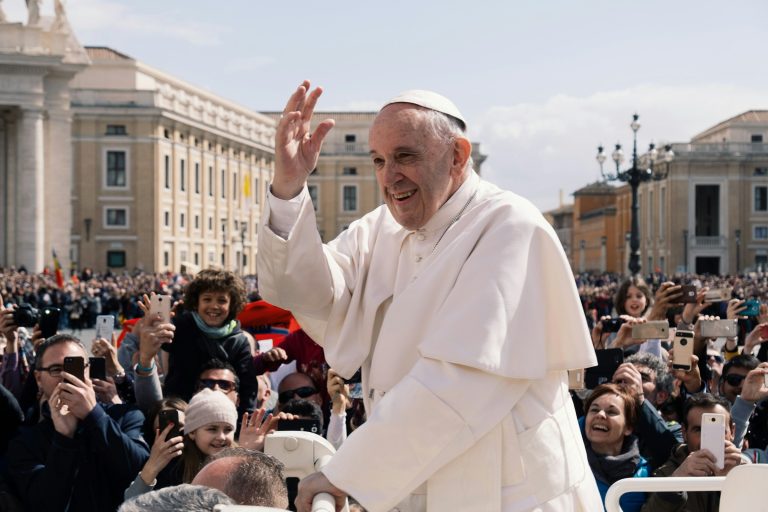
Pope Francis will surely be remembered for a long list of accomplishments. The dozen years of his papacy (2013 to 2025) witnessed strenuous efforts to promote reform within the Catholic Church. While far from perfect and complete, the measures promulgated by Francis to reshape Vatican finances, to respond more proactively to clergy sexual abuse, and to reorganize the central bureaucracy (or Curia) of Roman Catholicism represent major achievements for any pope. But even more remarkable were the contours of his moral leadership in matters of global social justice, reaching well beyond specifically religious matters. The four items treated below deserve a place on any list of the achievements of the first Jesuit pope.
First, Pope Francis emerged as one of the greatest advocates for environmental sustainability. While he may have a few prominent rivals in this regard (one thinks naturally of Al Gore and Greta Thunberg), the lasting effects of Francis’s efforts to raise consciousness of the urgent need for change will be enormous. His 2015 encyclical letter Laudato Si’: On Care for our Common Home is the richest and most detailed document from any religious leader addressing the urgency of preserving our natural environment. While Popes John Paul II and Benedict XVI greatly advanced the teachings of the Roman Catholic Church regarding the environment, it was Francis who placed ecology at the center of the church’s social concerns. This item deserves top billing on any list of lasting papal accomplishments because raising awareness of the dire need for “ecological conversion” (a phrase introduced by Francis himself) is of existential importance for all of humanity.
Second, Francis will surely be remembered as a great advocate for the needs of refugees and migrants. The very first pastoral travel of his papacy (July 8, 2013) was to a forlorn spit of land in the middle of the Mediterranean Sea called Lampedusa, often referred to as “the isle of tears,” then home to thousands of migrants. His aim was to express solidarity with them, an intent he’d reprise many times in the course of his four dozen international visits. In a world that has recently recorded the greatest number of refugees in history, Francis emerged as somebody committed to “people on the move,” those struggling for a better life, or even for mere survival in the face of inhumane conditions in their original homelands.
Third, Francis will be remembered as a peace advocate par excellence. While all recent popes have rejected violence and denounced armed aggression on the international scene, Francis has significantly expanded the existing papal playbook of diplomacy — leveraging the “soft power” that prominent religious leaders possess in the interest of peacemaking. His approach deserves to be described with the newer terms “conflict transformation” and “peacebuilding,” as he paid close attention to building up conditions that favor peace, such as in his advocacy for ending the global arms trade that so often exacerbates conflict and creates civilian victims. Cultivating many personal relationships with world leaders, Francis contributed to numerous peace processes and negotiations to resolve simmering conflicts. He played decisive roles in progress towards peace in various regions of the world — from his native Latin America (especially in promoting the Colombia peace accords) to Africa (particularly with his diplomatic initiatives in South Sudan and Central African Republic) and elsewhere. The ongoing conflicts in Ukraine and the Middle East clearly caused great anguish for Francis; despite his best efforts to encourage peaceful settlements in each context, deadly conflict continues to exact an unbearable toll on innocent civilian lives.
Fourth, Pope Francis will be remembered for his tireless advocacy for worker justice and his heartfelt efforts to counteract economic inequality. His analysis of the structural dimensions of issues of economic justice and distribution delved brilliantly into the root causes of exploitative patterns of production and trade. His first major teaching document (“The Joy of the Gospel”) issued a sharp rebuke to a global capitalist system run amok. Paragraphs 52 to 60 of that November 2013 apostolic letter urge the reader to “say no to an economy of exclusion,” “no to the new idolatry of money,” “no to a financial system which rules rather than serves” and “no to the inequality which spawns violence.” Indeed, the two most frequently cited soundbites from this document state the case Francis seeks to make in no uncertain terms: “Such an economy kills” (par. 53) and “Inequality is the root of social ills” (par. 202). As with his peace agenda, Francis expanded the previous papal repertoire of responses with a heightened rhetoric that captures the urgency of his message regarding social reform. Francis backed up these provocative words with substantial actions, taking every opportunity to support struggling (and even striking) workers and convening creative gatherings of community organizers (he sponsored an innovative series of “World Meetings of Popular Movements”) to effect real change.
Nobody can reliably predict the long-term legacy of Pope Francis. He will most probably be remembered many decades and even centuries hence as a creative innovator and as a guardian of Catholic social justice advocacy, faithful to the strong commitments of his papal predecessors over the previous century. Perhaps the best indicator of this combination came after the death of Francis: the papal conclave’s selection on May 8 of a successor (Leo XIV) displaying a remarkably similar dedication to the many faces of social justice. The first-ever American pope chose his papal name to honor the author of the first papal encyclical (the 1891 teaching document Rerum Novarum) to place the Roman Catholic Church squarely on the side of the working classes, as it expressed strong reservations about the exploitative practices of unbridled capitalism at the height of the Industrial Revolution. Like Pope Leo XIII, Leo XIV has already expressed his intention to use the papal office to vigorously promote peace, social justice and the rights of the marginalized. One can easily imagine Pope Francis smiling down from heaven upon his successor with an approving nod.
Thomas Massaro, S.J., holds the Laurence J. McGinley Endowed Chair in Religion and Society at Fordham University. A Jesuit priest and scholar of Catholic social thought, his recent books include Mercy in Action: The Social Teachings of Pope Francis (Rowman & Littlefield, 2018) and Pope Francis as Moral Leader (Paulist Press, 2023).
Image Credit: Photo by Ashwin Vaswani on Unsplash.