
In January 2024, I became the subject of a TikTok conspiracy theory. The corner of the social media landscape concerned with me was small, and the window of theorizing short, but for a moment strangers seemed convinced that the person singing while being escorted in zip ties through the US capitol building could not possibly be a Mennonite pastor.
Their suspicion was understandable. On January 16, 2024, I walked into the rotunda of the Cannon House Office Building in Washington, DC, sat down on the floor, and began singing in four-part harmony with more than 150 other Mennonites and interfaith allies. From under our black jackets, we unfurled banners painted in the repeating square pattern of quilts, adorned with slogans: “Let Gaza Live,” “Send Food Not Bombs,” “Mennonites for a Ceasefire.”
For those who tuned in on the livestream (or watched clips later on TikTok), the banners and songs immediately called to mind the stereotypical images of North American Mennonites. But the act of nonviolent civil disobedience (not to mention the livestream) seemed incongruous. Random corners of the internet commented, “That’s not a real Mennonite!”
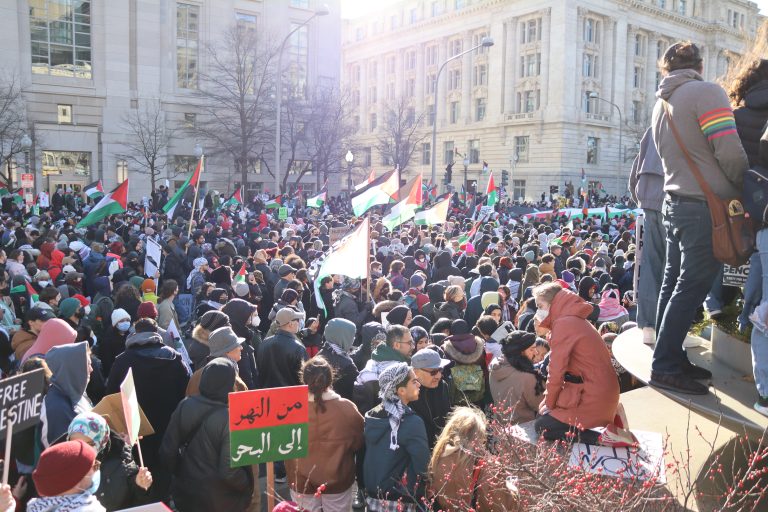
But, in fact, many of the people who sang with me were members of Mennonite Action, a new organization formed in response to the explosion of global resistance to the US-funded Israeli genocide in Gaza. At our protests, Mennonite Action leaders deliberately deployed religious and cultural markers familiar to both Mennonites and those outside the church.
In the history of activism, we are hardly the only ones to do this. Some of the largest acts of civil disobedience in the United States have been rooted in the symbols, ritual practices, and theologies of different faith communities. This was true in the Civil Rights Movement of the 1960s and in the sanctuary movement of the 1980s. Two months before we Mennonites got arrested, we sat in the Canon House Rotunda singing with nearly four hundred Jewish members of Jewish Voice for Peace led by a cohort of anti-Zionist rabbis. And three months after our arrest, around fifty Christian clergy and faith workers in stoles and collars blocked the Senate Cafeteria in opposition to the starvation of Gazans, crying out: “Woe to you who eat while others go hungry!” (Luke 6:25). While I coordinated jail support for the action, my pastor father notched his first arrest.
By mobilizing the symbols of Mennonite faith, a tradition not known for political protest, Mennonite Action intervenes in the dominant narrative of US Christian support for Israel’s genocide. Taking action “as a Mennonite collective” also organized Mennonites into the movement in a new way. Thus, as Jonathan Smucker, Tim Nazfiger, and Sarah Augustine point out, while “the tactics of attending protests, meeting with elected representatives, and writing letters to the editor… may not be new to many Mennonite Action participants…. For a significant portion of Mennonite Action participants, this is their first time attending any kind of protest or being involved in any social movement.”
These direct action campaigns took inspiration from three interlocking movement traditions: the Momentum escalation model, religious-based organizing in the Black Lives Matter movement, and anti-imperialist organizing among US Christian activists. All three traditions were committed to two crucial values to help organize religious communities: faithfulness and strategy.
A quick roundup of phrases I’ve heard seasoned organizers use to describe the religious left in the United States: disorganized, timid, uncreative, underresourced, all bark and no bite, pathologically afraid of power. In short, we appear faithful, but hardly effective. These assessments could apply to the US Left more broadly, but they speak to the perils of religious organizing in particular. We—and here I write as a Christian pastor—love to “be a witness.” We stand on the street corner holding signs week after week, without any plan for how we will build power and create change. Many books have been written saying as much, often by people with vastly different visions of what should be done to bring genuine and lasting change. So instead of diagnosis and prescription, this is a patient history. It is precisely this inheritance that Christians organizing in solidarity with Palestine are attempting to break from, drawing on methods to make sure that faithful organizing remains strategic and effective.
Momentum organizing has been the groundwork for this commitment and is best known by its most visible incarnations: the Sunrise Movement, IfNotNow, and other organizations. While the theory and practice of these groups continues to develop, the Momentum training organization traces its origins back to 2014 and to the theoretical work of Mark Engler and Paul Engler who understood organizing in light of a whole “social movement ecology” of different actors engaging different strategies for change that reinforce and support the movement as a whole.
There are many models of social movement ecology, but the Englers’ map highlights a method for organizing that incorporates distinct yet unified theories of change. A healthy movement involves personal transformation, creating alternative institutions, and fighting to change dominant institutions. The category of changing dominant institutions can be divided further into three more specific strategies: inside game efforts (like electoral campaigns), structure-based organizing (like unions), and mass protest.
Momentum organizing is born out of a belief that fighting for new institutions and revolutiozing old ones can coexist in one movement. The Englers are excellent historians again: momentum-driven organizing, such as the Southern Christian Leadership Conference’s campaign in Birmingham in 1963, “is fundamentally based on deploying disruptive power but… takes a deliberate and disciplined approach to mass mobilization.” The Southern Christian Leadership Conference was successful because of its multi-pronged front.
Both Mennonite Action and Christians for a Free Palestine began their public organizing with a cycle of mobilization and absorption drawn directly from the Momentum playbook. This cycle moved through 4 stages: (1) a mass Zoom call announced via social media; (2) a day of distributed protests organized locally but using similar tactics, targets, and messaging across them; (3) a convergence in Washington, DC for a single direct action targeting elected officials; and (4) another mass call to welcome in new people and build shared identity for future actions.
This cycle introduced hundreds of people to the strategy and theory of change of these organizations, many for the first time. While not everyone stuck around, the combination of public invitation, strong use of commonly-known symbols of the faith, clear and specific action steps, and the urgency of the moment let dozens of people take leadership in particular ways across the country.
But organizing is not an exact science. Momentum-trained organizers talk a lot about the importance of culture and cultural organizing. And few movements have done more to mobilize culture and change the internal culture of direct action campaigning in the past twenty years than the Black Lives Matter movement.
Few would recognize the importance of religion to the BLM movement since its very beginning during the uprising in Ferguson in August of 2014. As theologian Shannon Craigo-Snell wrote a few months after Ferguson,
[BLM] is religious because people of faith are key to its operation and sustenance. It is religious because the protesters are participating in prayer and liturgy together to sustain their work (the recitation of a poem by Assata Shakur, for example). And it is religious because it is staking a truth claim about the value of black life that transcends the rhetoric and realities of American culture.
Ann Gleig, scholar of religion, notes that the Movement for Black Lives (that is, M4BL, the diffuse networks of activists and organizations) “is committed to spiritual principles, such as ‘healing justice’– which uses a range of holistic approaches to address trauma and oppression by centering emotional and spiritual well-being — and ‘transformative justice’ which assists with creating processes to repair harm without violence.”
While Mennonite Action is predominantly white and Christians for a Free Palestine is majority white, they have still incorporated commitments to community care and healing justice in their internal organizing. In particular, Christians for a Free Palestine have kept these principles central to their organizing strategies through the use of movement chaplains. Originating in anti-racist organizing in Nashville, movement chaplains tend to the spiritual needs of participants in the planning, carrying out, and debriefing of a direct action. They help participants navigate trauma responses and negotiate conflict.
In early May of 2024, I gathered with other leaders of Christians for a Free Palestine (CFP) at a retreat to plot our next steps forward. The site of our meeting was auspicious. The Kirkridge Retreat Center, nestled in the Pocono Mountains of Pennsylvania, has been the site of similar meetings for previous generations. In 1983, Kirkridge hosted a group of Christians concerned that Ronald Reagan would invade Nicaragua or El Salvador, after pouring weapons and money into right-wing death squads in both countries and invading Grenada. They wrote and published the “Pledge of Resistance,” promising to take direct action to stop any invasion of the Central American nations.
Within two years, 80,000 people across the country had signed on, including hundreds at public sign-on days in the streets of cities like San Francisco. Signers were recruited into trainings and “practice demonstrations.” Scholar Christian Smith points out the movement’s diverse tactics:
[They] blocked the gates of Contra-training military bases; staged funeral processions and mock ‘die-ins’ in city streets and congressional offices; ran ‘Stop the Lies’ advertisements in newspapers and radio stations;… fasted in protest for weeks on the Capitol steps; rented planes and flew huge ‘U.S. Out of Nicaragua Now!’ signs over big college football games;… erected plywood walls in shopping centers painted with the names of hundreds of Nicaraguan civilians killed by Contras;… [and] bird-dogged 160 campaign appearances of forty pro-Contra congressional candidates seeking re-election.
In 1987, hundreds of Pledge signers blocked the entrance to the CIA, an action that CFP organizers explicitly reflected on when planning their first DC actions in April 2024.
The Pledge of Resistance served as the direct action arm of the Central America solidarity movement in the US. It was part of a large-scale solidarity movement with actions that consisted in organizing group-led delegations to Latin America, establishing sanctuary churches, and lobbying elected officials. Mennonite Action and CFP play a similar role today, strengthening various denomination-based Palestine-Israel Networks (PINs), which usually focus on education and advocacy for divestment, and advocacy groups like Friends of Sabeel North America (FOSNA; Sabeel is the center of Palestinian Liberation Theology based in East Jerusalem) and Christians for Middle East Peace (CMEP).
The Pledge of Resistance is one of many living memories of Christian anti-imperialist organizing in the belly of the beast. Its focus on nationwide, large-scale mobilization (a la the Englers’ “momentum-driven organizing”) and its position as a left flank of the movement make it a key touchpoint for recent Palestine solidarity organizers. Alongside the more recent organizing traditions of the Movement for Black Lives and Momentum, it continues to inform how US Christians can organize at this critical moment in the struggle for Palestinian liberation.
These traditions of mobilization and organizing do not seek merely to instrumentalize the power in religious symbols, practices, and faith communities. Instead, they take the faith of communities and participants seriously and root their practices in the culture and history of a radical Christianity that emerged in the United States. If we are to be effective in dismantling US imperialism, we need to understand the traditions and tools we are drawing upon. If radicals both in and outside the Christian tradition wish to engage this work, either to strengthen it or transform it, it helps to know where it comes from. And it helps to know that when we take action, we are real Christians. And we real Christians are indeed willing to risk arrest if it means a free Palestine.
Jay Bergen (they/them) is the pastor at Germantown Mennonite Church in Philadelphia, and an organizer with experience in climate direct action, broad-based abolitionist organizing, Palestine solidarity, and immigration justice.
Image Credit: Elvert Barnes from Silver Spring MD, USA, CC BY-SA 2.0 <https://creativecommons.org/licenses/by-sa/2.0>, via Wikimedia Commons.