
The salakot is a familiar companion to farmers across the Philippines. A wide brim hat with a woven texture, it is a symbol of local labor, land, resilience, and dignity. When I entered Union Theological Seminary, the Philippines, I did not expect this everyday object of farmers to become cen tral to my work as a pastor, educator, and theologian. But there it was, the name and symbol of the chapel at UTS. Located at the center of the seminary, the Salakot Chapel symbolized the presence of the sacred in the lands of the Philippines and the stories of its toiling farmers.
The chapel’s intentional design drew my attention. Unlike many church buildings, its open sides welcome wind, birds, children’s laughter, and the everyday disruptions of life into the services and liturgy. Worship unfolds in constant conversation with the world. During service, the space invites us to think about a theology that does not retreat from life, but remains open to it, grounded, and responsive to what is happening beyond the chapel’s walls.
Instead of lifting our eyes toward high ceilings meant to evoke a distant transcendence, we lowered our gaze toward the land and toward the people who feed us. Instead of centering a pulpit at the highest point, relegating authority to a singular figure, the chapel contained open seating in a circle or semi-circle, allowing face to face encounters. Instead of muting the presence of the more than human world, the chapel was designed to welcome the sounds and sights of swaying trees, the chirping of birds, the songs of children, and the cries from nearby communities. The design was radical theological pedagogy. Without speaking a word, the space worked on our imagination to remain in dialogue with the world. The chapel reoriented my sense of where theology begins, redefined whose voices matter, and reimagined what Christian education ought to be.
At the time, I did not realize that the Salakot Chapel was preparing me for something beyond itself. Its circular shape, open walls, many doors, and yielding boundaries were quietly forming me to resist rigid, inherited ways of thinking, learning, and living, which were fully influenced by patriarchal and colonial systems. Sitting on floors, facing the breeze, gathering in a circle, trained my body as much as my mind. These rituals cultivated attentiveness, vulnerability, and the capacity to remain unfinished. What I later came to understand is this: the Salakot Chapel was never meant to hold us in. It was meant to send us out.
Its form echoed the salakot worn by farmers to protect themselves from the sun during their work. Slowly, the direction of my formation became clear. The chapel pointed toward the naka-salakot, the salakot wearing farmers.
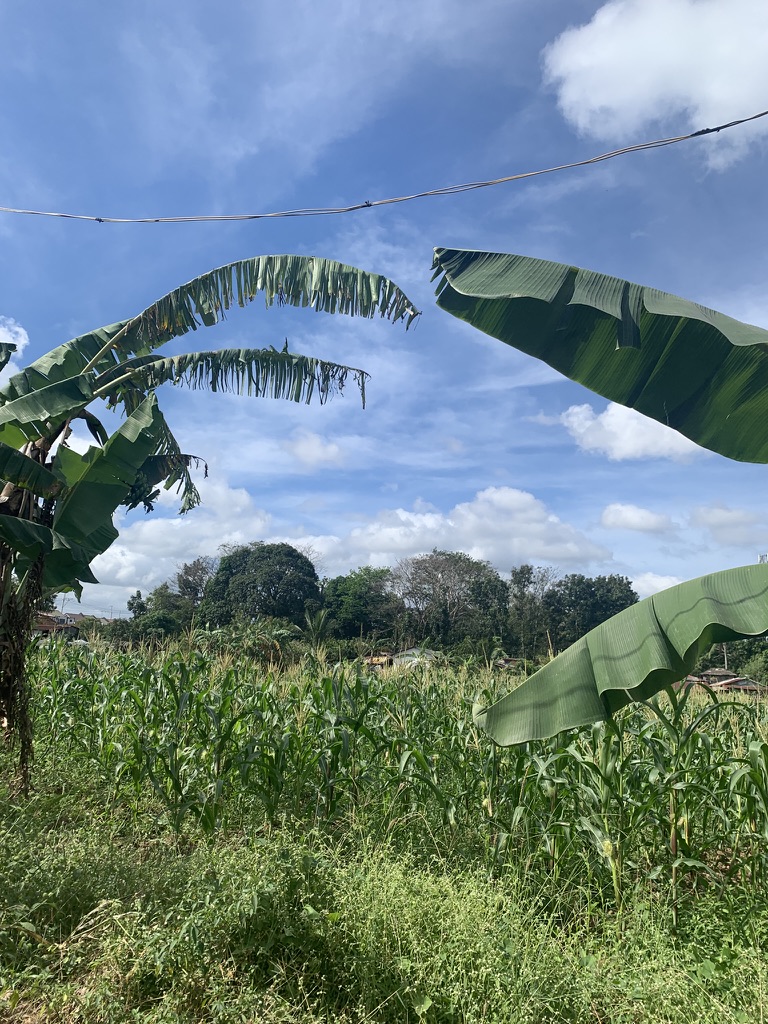
Today, the naka-salakot are struggling for their right to livelihood, land, and life. They continue to organize themselves, defend the land that sustains them, and refuse erasure as the government tries to take their home away for new development. They teach their children to stand up for what is right, to remain united at all times—especially in moments of hardship and fear. They continue to plant, to tend the soil, to wake up in the morning, and to choose life again and again. We can witness this hope carried in their songs sung at dusk, in poems spoken during gatherings, and in stories passed from elders to children, narratives that remember loss, name injustice, and insist on dignity. I first immersed myself with the naka-salakot when I arrived at Lupang Ramos, a contested agricultural land subject to government repression and land grabbing. It is farm land, the only remaining agricultural land in the city. It is surrounded by malls, subdivisions, hotels, national highways, and factories. Lupang Ramos stands out from the concrete developments, middle-class consumption, and version of progress defined by current politicians and business owners.
As a seminarian, I wanted to learn from the naka-salakot about how they resisted. I listened for sharp concepts, waited for clear lessons, and tried to identify themes as if preparing notes for a sermon or a paper. But the farmers refused that structure. Nothing came in tidy outlines. Nothing was reducible to bullet points. They welcomed us not with instruction, but with life itself. Active struggle was the teacher, and its method was immersion—pakikipamuhay—not explanation. In Lupang Ramos, learning happened through living, and the struggle revealed its lessons slowly, insistently, and intentionally, in community life. Through shared meals, work, and conversations, they taught us what we needed to learn without ever naming it as a lesson.
Living with them meant joining their daily rhythms of planting, guarding the land, organizing, and worshiping in the midst of threat and uncertainty. I witnessed harassment from security forces, heard stories of repressive violence, and saw how the naka-salakot’s struggle for land was inseparable from their struggle for life. Worship in Lupang Ramos emerged from this reality: we celebrated communion using the fruits of their labor, such as corn, bananas, yams, and coconut juice. We read Scripture through the lens of land and survival. They shared songs, poems, and stories in their own language. In this immersion, theology became embodied, communal, and urgent. Among the naka-salakot, I recognized something immediately familiar. The attentiveness shaped under the salakot chapel’s roof—listening to wind, sensing shifts, noticing what is spoken and what is withheld—became essential in the fields. Among the farmers, this attentiveness was not a spiritual metaphor. It was necessary for survival. The ability to read land, tension, silence, and danger was knowledge forged through struggle.
I also realized that the residents of Lupang Ramos were not only farmers. They were also theologians and educators. Through their work, they gave me a different perspective on hope. Among struggling farmers, hope is not a feeling they wait to have, nor an optimism about certain outcomes, nor certainty that justice will come. Hope is an imminent, repetitive, struggle. Every day, the farmers of Lupang Ramos work despite knowing their land may be threatened and their harvests destroyed by private armed groups, military presence, and public officials aligned with corporate interests. Nevertheless, they wake up and tend their fields, bending their bodies toward the earth another day. Their hope emerges in their refusal to disappear despite the precarity created by oppressive economic and social conditions.
Immersing with the naka-salakot transformed how I understood scripture’s vision for justice too. Justice was no longer an abstract principle. It is a way of being that takes root in the land itself to transform lives and social conditions. The prophet Isaiah gives language to this vision:
“Then justice will dwell in the wilderness,
and righteousness abide in the fruitful field.”
(Isaiah 32:16)
I am no longer a seminary student at UTS, nor am I immersing myself with the naka-salakot. But their daily struggles for hope and justice have stayed with me. Hope and justice, I now understand, must be tended, protected, and returned to each day. In this, hope and justice are like the fertile lands of Lupang Ramos. They take shape where people insist on staying, planting, and refusing to surrender life to fear. In the farmers’ daily decision to wake up, return to contested soil, and care for what feeds the community, justice and hope find a place to live.
Between the chapel and the fields, a bridge emerged—between classroom and movement, between church and struggle. Faith crossed that bridge and was transformed. I learned that the church is most faithful not when it remains protected, but when it allows itself to be interrupted by the lives of those who struggle. The farmers helped me to see that faith must internalize the movements of people. Only then can it be tested, refined, and made real.
This formation did not end at national borders. Union Theological Seminary planted in me a vision of faith and justice that reaches across oceans and cultures. Wherever we are sent, whether migrant congregations, grassroots movements, or global struggles for dignity, the formation under the salakot-shaped chapel reminds us to carry a grounded, critical, and accountable imagination. It reminds us to remain responsible to the people whose lives shaped our learning.
Looking back, I now see that the heart of Christian education is not about imposing truths onto people’s lives. It is about learning to read life itself as revelation. It is about honoring the wisdom of those whose labor sustains the world yet remains ignored. It is trusting that God is present not only in Scripture, but in fields of struggle, in calloused hands, in whispered fears, and in the brave decision to wake up and live another day.
To learn from the naka-salakot is to learn humility.
To learn with them is to learn solidarity.
To learn beside them is to learn courage.
To learn through them is to learn liberation.To learn from their waking each morning is to learn the practices of radical hope.
Radical hope is not an abstract belief or a future promise. It is the discipline of rising without guarantees. It is faith practiced through tired bodies, open hands, and shared experience. This hope does not wait for justice before acting; it acts so that justice might still be possible. It does not depend on safety before loving; it loves in order to survive. In the farmers’ daily decision to wake up, to stay, and to continue, hope becomes resistance and a way of remaining human.
This is the kind of radical hope sustained not by individual resolve alone, but by organized resistance, collective power, and shared struggle: the slow, disciplined work of people refusing to face injustice by themselves.
This is the harvest the naka-salakot offer us.
Hazel Joyce D. Salatan is a PhD student in Christian Education and Congregational Studies at Garrett-Evangelical Theological Seminary and an ordained elder in The United Methodist Church. She is a scholar-activist, feminist woman of color, and educator whose work is grounded in liberation, solidarity, and transformative praxis.
This piece, along with other selected pieces from Issue #1: The Radical Hope is available to read for free online for a limited time. You can order the print or digital version of the magazine at the link here.