
Editor’s Note: This review was written before the passing of Richard B. Hays on January 3rd, 2025.
If only it were so easy: if only one well-argued book (or, God forbid, a book review) could settle every debate about the Bible and homosexuality. But arguments fashioned with the intellectual resources of one Christian tradition don’t necessarily travel well to other traditions, and even among the jurisdictionally likeminded, disagreements on first principles are inescapable. Anyone who sets out to write on this topic surely knows that their word will hardly be the last, but why even bother if you aren’t setting your aspirations high? Authors may humbly submit that a book on LGBTQ inclusion in the church won’t change the world, but it might change a few minds, or even save a life. Doesn’t that at least make it worth trying? Perhaps, but if you ask me, the enterprise is doomed from the start.
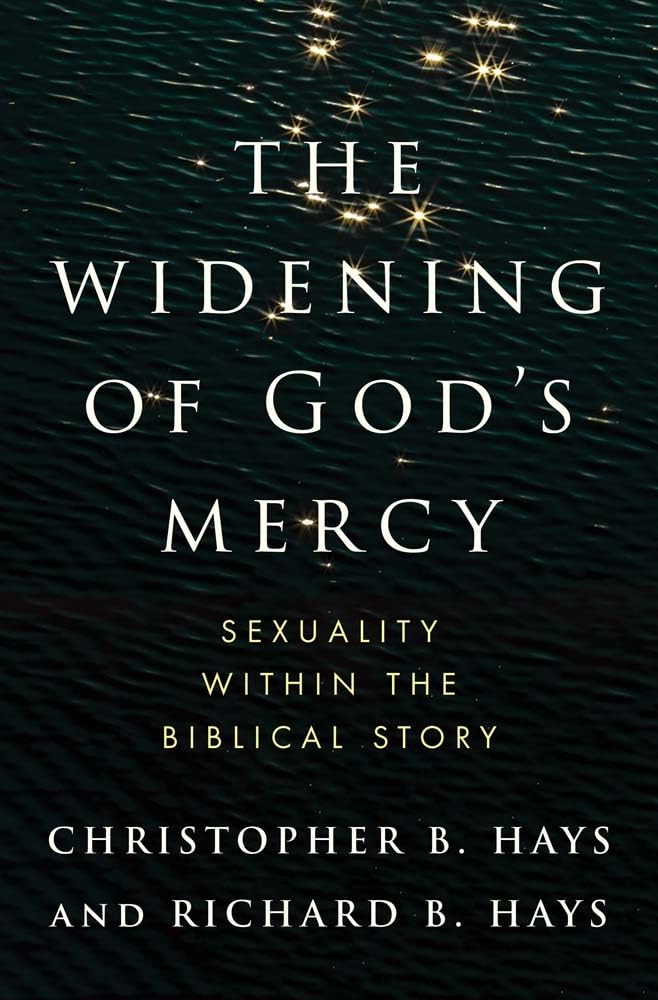
Nevertheless, New Testament scholar Richard B. Hays and his son, Old Testament scholar Christopher (Chris) B. Hays, are the latest writers to give it a shot with their coauthored book The Widening of God’s Mercy: Sexuality Within the Biblical Story. I was previously unacquainted with the Hays family—the reputations of a Methodist minister and a Presbyterian minister are unsurprisingly not of much interest on my home turf, the Eastern Orthodox church—but for those familiar with the authors the arrival of this book may come as somewhat of a shock. Richard Hays is formerly best known for his 1996 book The Moral Vision of the New Testament, in which he purports to have interpreted Biblical injunctions on sexuality conclusively. “[M]arriage between man and woman is the normative form for human sexual fulfillment,” Richard wrote back then, “and homosexuality is one among many tragic signs that we are a broken people, alienated from God’s loving purpose.” As Chris puts it, his father’s work “made conservative views about LGBTQ people seem respectable and civilized.” The time has come, father and son agree, to set the record straight—so to speak.
Much of the popular literature of the past 15 years by and about LGBTQ people in the church is characterized by theological analysis grounded in often intensely personal stakes. Widening takes its place alongside titles like God and the Gay Christian: The Biblical Case in Support of Same-Sex Relationships (2015), Washed and Waiting: Reflections on Christian Faithfulness and Homosexuality (2010/2016), and Scripture, Ethics, and the Possibility of Same-Sex Relationships (2018), to name just a few of the texts that adopt this approach with differing results. Like the gay authors of those books, the straight authors of Widening have their own investments in writing about sexuality. For Richard, guilt over the way his Moral Vision has been wielded against LGBTQ people is a powerful motivator. Writing this new book, he hopes, will give him the chance “to repent of the narrowness of [his] earlier vision and to explore a new way of listening to the story that scripture tells about the widening scope of God’s mercy [emphasis his].” Chris doesn’t have an original sin of his own to atone for, save for a passivity that slowly changed over time into proactive acceptance. His journey mirrors the evolution of his Presbyterian Church’s stance on LGBTQ people, and it was kickstarted by institutional politics at his employer, Fuller Theological Seminary.
Alongside their personal stories, the authors clarify up front what they do and do not intend to accomplish in the short space of their book. In their introduction, they write that Widening will be a book about “the character of God,” something which they claim is all too often overlooked by religious conservatives. Unusually, it will have nothing to say about any of the so-called clobber passages used to deny LGBTQ people rights and compassion; the authors assert that the “repetitive arguments about the same set of verses, and the meaning of specific words, have reached an impasse,” before adding dismissively that these debates are “superficial and boring.” Opting instead for a macroscopic view of the Bible will, in their view, demonstrate that “the story of God and humanity is meant to be one of ever-expanding grace” in which the logical next chapter will be the full inclusion of “[t]hose who do not conform to traditional expectations for sexual orientation” in the life of the church.
To my displeasure, the authors outright state their disinterest in explaining their approach to Biblical hermeneutics, even scoffing at the word itself (surely an appendix for the curious would have been warranted?). But with some humility, they promise to stick to what they know, conceding their lack of scientific expertise and directing readers (in a footnote) to a Duke Divinity School reading list of queer theology rather than attempt to appropriate any insights from that discipline for their own book. As for their readership, the authors imagine a broad audience interested in a careful reading of the Bible. It’s unclear if they mean to include LGBTQ people in that picture.
Widening is divided into two main sections: in the first, Chris Hays presents the Old Testament case for reading the story of scripture as that of God’s ever-expanding mercy, and in the second Richard does likewise for the New Testament. The book is easy reading, mostly jargon-free and focused on the biblical text, presented chronologically from the creation narrative in Genesis through the Epistles of the New Testament; cringe and tossed-off references to pop culture are mercifully limited in number. Chris opens his portion of the book by referencing the eighteenth century theologian Jonathan Edwards (one of only a few extra-scriptural citations to be found before the footnotes in Widening). For Chris, Edwards serves a pertinent and premonitory role. Despite his genius, Edwards was fired by his congregation “for being too rigid and exclusionary about membership and sacraments;” “his understanding of divine love was skewed,” with disastrous consequence for his theology; and perhaps most importantly for Chris’s purposes, “his preaching sparked a rash of suicides and suicidal ideations among his congregation.”
In a subsequent chapter, Chris cites statistics from a 2020 study showing the higher rates of suicide attempts among LGBTQ youth compared with their heterosexual peers (the connection back to Edwards is left implicit). Foregrounding the way obeisant attitudes toward scripture among well-intentioned theologians and preachers can abet real harms, Chris fills his section of the book with stories from throughout the Old Testament of God innovating, changing his mind, becoming more merciful, or otherwise responding in surprising ways to people brave enough to challenge received laws and customs. Along the way Chris occasionally contrasts his arguments with those made by earlier Biblical interpreters in order to dismiss the latter as “prooftexts,” without ever clarifying what he means by that nor explaining why the present work’s use of scriptural citations should be exempt from that same charge.
Richard’s half of the book picks up with the life of Jesus and works its way up to the misadventures of the Apostles. For Richard, the key to the New Testament is to start with the theme of “eschatological reversal,” aptly demonstrated by Jesus in the Beatitudes and by Mary in the Magnificat. Starting from this vantage point allows us to read the New Testament as the ongoing story of God’s merciful character becoming manifest in the person and actions of Jesus as he overturns received interpretations of the law and dismantles barriers to membership into what would become the early church. Extrapolating from the Biblical text, Richard theorizes that contemporary debates around sexuality should take after the primary characteristics of the Jerusalem Council in the book of Acts: “imaginative attention to scripture, attentive listening to stories of how God is already at work, and careful conversation in community.” Reuniting for a concluding chapter, the authors cosign their vision for the church one last time, reaffirming that the “trajectory of mercy” in scripture “leads us to welcome sexual minorities no longer as ‘strangers and aliens’ but as ‘fellow citizens with the saints and also members of the household of God’ (Eph 2:19).”
It’s no small feat that the authors are able to strike a tone that’s at once authoritative and gentle. There’s a fine line separating subject matter experts from know-it-alls and the authors consistently present as the former, refraining from ad hominems and cheap shots against their enemies. While they stand firm in their opposition to conservative critics who wouldn’t want to extend any mercy to LGBTQ people, ressentiment is not the primary driver of this book. The authors’ inquiry into the character of God is made in earnest. You truly get the sense from reading Widening that the Hays’ are eager to (re)introduce readers to the loving and merciful God they have come to know better through their close readings of scripture.
Yet this should not distract from the serious shortcomings of their argument. The central thesis about God’s widening mercy toward LGBTQ people poses problems from the start. When it comes to matters of sexuality and gender (the latter of which the authors aren’t too concerned about), aren’t the ones most in need of mercy the people, like Richard, who have used their power and authority to uphold oppressive sexual and gender regimes in the church and society, not those whose sexualities and gender identities deviate from an unjust norm? As written, the authors’ argument invites a troublesome question of theodicy: if the inclusion of LGBTQ people in the church has always been an intended part of the gradual unfurling of the biblical story, why should LGBTQ people want to have anything to do with a God and an institution that allowed so much pointless suffering in their communities in the interim?
In the very first words of the acknowledgements that open the book, the authors confess that they “do not remember ever writing anything that made us conscious of the limitations of our own perspective to the degree that this book did.” Why then did they choose to approach the task at hand with rugged individualism, rather than treat it as an opportunity for collaboration with the marginalized? Even a cursory familiarity with the literature produced by LGBTQ Christians could have strengthened their book, as so much writing by the queer faithful reveals how scripture has been a source of encouragement that speaks to their specific needs qua gay, bisexual and transgender people. Some LGBTQ Christians have found in the story of Jesus telling Lazarus to come out from his tomb a life-affirming analogy to the process of coming out. Others look to the Old Testament examples of Ruth and Naomi or David and Jonathan for examples of same-sex love and kinship enshrined in church history that can serve as inspiration in their own relationships. Richard Hays at least mentions the baptism of the Ethiopian eunuch in Acts, but he doesn’t make explicit the connection that some trans readers of the Bible have, seeing in this story the inclusion of trans and gender nonconforming people in the church from its inception.
On the other hand, what if inclusion itself is the wrong frame of reference for this conversation? In the book’s sole reference to queer theology, the authors issue a caveat that their book “is not meant to take the place of that literature; rather, it is meant to complement those significant perspectives.” Putting aside for the time being how talk of complementarity is enough to trigger any LGBTQ person’s fight or flight response, it doesn’t seem like the authors fully grasp just how much of their project is actually in conflict with the claims of queer theology. While there is no shortage of popular apologetics for LGBTQ inclusion like what Widening has to offer, for queer theology properly speaking the very ideas of apologetics and inclusion are anathema. Such is the view of Marcella Althaus-Reid, one of the foundational theologians in this field and the author of Indecent Theology and The Queer God. If you, like me, lack access to academic libraries and black market PDFs, you may have to settle for the summary of Althaus-Reid’s thought laundered by Yale Divinity School professor Linn Tonstad in her primer Queer Theology: Beyond Apologetics.
Tonstad’s book takes direct aim at one of the conclusions reached in Widening. Anticipating Richard Hays’s argument that it is “reasonable” for the church to hold same-sex relationships “to the same standard of monogamous covenant fidelity that the church has long commended and prescribed for heterosexual marriage,” Tonstad casts a sheepish glance back at the fathers of the early church (who are also largely absent from Widening). For these early theologians, “lifelong, ‘heterosexual,’ monogamous marriage was an accommodation to human weakness, not the ideal Christian state;” questions of sexual ethics were subordinate to concerns about the corruptibility of the body and its subjection to death. If conformity to a relational model patterned after the relatively modern idea of heterosexuality shouldn’t be the horizon for LGBTQ people in the church, then what should? Here Tonstad enlists Althaus-Reid to lay some conceptual groundwork for more creative theologies.
Born and educated in Argentina, Althaus-Reid’s theological thinking is rooted in liberation theology and also a rebuke to it. While taking liberation theology’s challenge to capitalist and colonial systems seriously, Althaus-Reid insists that theology must go further and recognize both the bodied, sexual realities of the poor and the sexual and gender ideologies that oppress them. I personally find much of Althaus-Reid’s work (at least as summarized by Tonstad) to be methodologically exasperating. Perhaps I would feel differently if I, like her, were committed to a strictly materialist theology—but I would agree with her on the need for theologies that can recognize and interrupt the violent sexual and gender regimes that capitalism necessarily works with and through. What we actually do after this recognition, how we actually interrupt this violence, is an open question that Tonstad concedes has been left unsatisfactorily answered since Althaus-Reid’s death in 2009. In contrast to how Widening approaches things, we might start by recognizing that the threshold for harm against LGBTQ people is much lower than suicidality.
Early on in Queer Theology, right before launching into a systematic dismantling of the most common apologetic strategies used by proponents of LGBTQ inclusion in the church, Tonstad writes, “[t]he arguments [for inclusion] one finds convincing are the arguments for the view one has come to have—for reasons other than the argument!” This seems to be the case with Widening: both Richard and Chris have changed their mind on LGBTQ people after real-world encounters with them, which necessitates an ex post facto explanation for intellectual journeys they both have taken for reasons other than simply discovering something new about scripture. Richard’s apologies for the impact of his former words ring genuine; at the same time, the book’s frequent asides explaining how Richard never intended for his 1996 work to do harm, coupled with the authors’ general disinterest in actually talking about sexuality and gender, make it hard to shake the impression that Widening is excessively interested in rehabilitating its authors’ images. Mercy is not an altogether uninteresting topic for a book of scriptural interpretation but for these authors in particular repentance seems like the better biblical theme to contemplate. Unfortunately for them, I don’t think making amends is quite so simple as writing a book either.
Tim Markatos is a designer and critic who lives in Washington, D.C.