
An academic’s biography is rarely interesting. What an academic felt or did matters less, or at least should, than what they thought and argued. Whether Kant or Hegel were influenced by their Prussian culture has little bearing on whether the arguments for synthetic apriorism or a philosophy of history bear out. Consequently an academic autobiography is destined to be at best an indulgence, at worst perfunctory and besides the point. Almost no one says the same about spiritual autobiographies, which in the Christian tradition are a noble genre that go back at least to St. Augustine. A good spiritual autobiography is intended to universalize the particularity of a given life even as the spiritual subject tries to apprehend transcendent and oceanic truths. A work like Confessions or Martin Luther King’s autobiography is consequently both deeply personal and profoundly depersonalized, showing the specific path a soul walks in order to reach a destination toward which all are called.
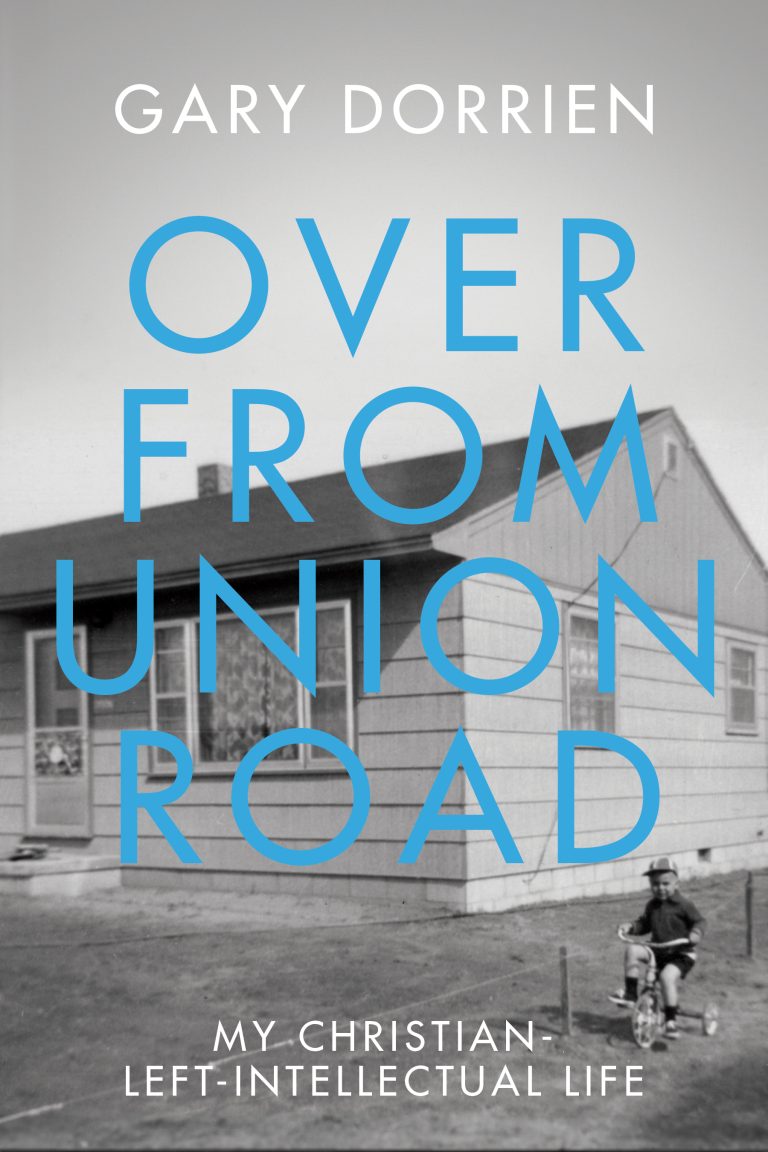
Combining these two genres together is trickier than it might appear, which is all the more reason to admire Gary Dorrien’s Over From Union Road: My Christian Left-Intellectual Life. Dorrien is aware that he is a man that contains multitudes: Christian and left in a country that increasingly associates the former with reactionary nationalism, an analytically rigorous intellectual who makes no bones about the need for partiality in activism and faith that a more just world is still possible. That Dorrien has succeeded in not only chronicling such a life, but making its every strand seem integral to the other, is a testament to the mind and the spirit of one of our great teachers.
Born into very modest circumstances in Michigan, Dorrien describes himself as a shy and introverted kid mainly saved from ostracization by athletic talents. His close family is described with clear eyed generosity befitting a truly Christian outlook of loving a person not in spite of, but through, their inevitable but individuating flaws and sinfulness. Dorrien’s family is not described as especially religious or zealous. He became attracted to theology and philosophy early on, largely inspired by encounters with progressive icons like Martin Luther King jr. On Dorrien’s telling, he never planned to channel those interests in an academic career. But you know what they say about making God laugh by thinking you’re the one with a plan. He eventually became an accomplished theologian and activist, assuming numerous prestigious appointments that climaxed in becoming the Reinhold Niebuhr Professor of Social Ethics in New York. Dorrien also became a loving father and a husband. These happy tidings took a tragic turn when Dorrien’s wife passed and he became a young widower. Much of the heart of his autobiography naturally lies in delicately mapping these relationships.
Dorrien provides a key to interpreting his autobiography near its conclusion; also telling us something important about his self-conception after long, conscious reflection of a high pitch:
This has been a decidedly I-We-We-I memoir. I have never been interested in myself except as a participant in relationships and movements. I am far more interested in friends and loved ones, social justice causes, and intellectual trends than in myself, and I am painfully aware that my-self is a shy loner saved only by the love and grace of others. So now I have written a memoir that runs long on friends, causes, and intellectualism and short on how I carried brutal depression through my college years, why I had to be alone after we lost Andy, why Brenda [Dorrien’s deceased wife] is the main figure of chapters 4 and 5, and so on.
If I can be permitted to push back on Dorrien’s self-conception slightly, I think that isn’t quite true. One of the things he’s “interested in” isn’t like the others. Discussions of friends, loved ones, and social justice causes take up a large part of Over From Union Road. But so too do “intellectual trends.” Dorrien spends an immense amount of time discussing his first encounters with Marx, Kant, Michael Harrington, Hegel, Whitehead, liberation and Black theology, feminist theory, Reinhold Niebuhr, Tillich, and countless others. Indeed these “intellectual trends” and figures come alive again in Dorrien’s telling but in no small part because we learn, sometimes intensely, how their thinking and feeling became intertwined with and molded him. For Dorrien, intellectual trends are not just manna for a scholastic squabble to be fought out through back and forths in academic journals only a few people read. They are closer to Platonic lamps of the soul guiding it through waves of encompassing uncertainty. In this respect coming to know Dorrien’s thoughts about Hegel’s concept of God as an “intersubjective whole of wholes” means coming to know more about the man and what he stands for. His self-described insularity is not myopia, but a lifelong effort to gather together cares enough to break many of us.
Perhaps inevitably then the most engaging chapters are those that integrate the intellectual, spiritual, and relational, demonstrating in reflective prose something rather like Hegel’s effort to integrate all the thick dimensions of the world. For instance, the road to Damascus moment in his life seems to have been reading L.D Reddick’s biography of Martin Luther King, Crusader Without Violence. Dorrien describes how learning about King’s moral seriousness synchronized with his own efforts to read and understand the Bible as a source of the same virtues. Dorrien writes,
Reading the Bible seemed impossible to me-what were you supposed to do with the sprawling mass of whatever it was? Start at Genesis and just keep reading? That approach broke down twice. The artwork, however, was another matter entirely, reinforcing my fixation with the cross, as our Family Bible had artwork depicting the stations of the cross. Reddic was long on narrative and mercifully short on intellectualism, which was not how I experienced King’s book Stride Toward Freedom (1958). His chapter on what he studied at college and seminary sailed far above my head, a parade of Walter Rauschenbusch, Karl Marx, Friedrich Nietzsche, Mohandas Gandhi, Reinhold Niebuhr, and some personalist philosophers and theologians. This book planted the seeds of who I became…
Most of Over From Union Road is a meditative and unhurried account of how those seeds sprouted into a life unusually enabled to grow to its natural extent. As the precocious discussion of philosophers and activists suggests, even in ninth grade Dorrien was pretty clearly fitted to be a left-Christian intellectual. Dorrien presents himself as a natural introvert attracted to the world of ideas usually presented in books. From a young age he spent a lot of time reading and absorbing an enormous range of material. The Bible, MLK, Kant, Hegel and Tillich all make numerous appearances. But one gets the sense it was Dorrien’s natural empathy that inexorably drew him out of himself to engage the world of praxis. Fortunately he became someone who would inhabit the world of theoretical ideas, while hoping with Marx that theoretical ideas could become a transformative material force when they are genuinely gripped by the wretched of the earth. Befitting the “I-We-We-I” approach, Dorrien is the kind of academic for whom even the usually very inward journey of the intellect is profoundly shaped by the outer world of people and history. Once upon a time I would have judged such an approach far too harshly, since it would seem to lack the kind of aesthetic purity that comes from the most remote kinds of philosophical personalities. Now I think that Dorrien’s approach is the wiser; indeed, that an inward journey of the intellect only gains significance from its relation to externality, since otherwise thought becomes mere nebbish scholastics and abstractions.
Very human moments in the book give the long passages on philosophy and political theory gravitas, reminding us of what Aristotle knew: that politics aims for the highest good because it impacts many very real people who depend on one another whether they wish to acknowledge it or not. Dorrien may think of himself as a loner, but the book doesn’t seem to bear that out either. He vividly describes an endless array of close friends long retained, family members cherished, and waxing love sometimes despairingly cut short before its time. Nowhere is the latter clearer than in the chapters on Dorrien’s late wife Brenda, who died young from cancer. In some of the most terrifying sections of the book, Dorrien describes how he “crawled into bed and held Brenda for the last time. She was still breathing when I drifted to sleep. Two hours later, I awoke, and she was gone.” This reminds us that life can simultaneously feel very short and very long, and at no time does this paradox express itself more cruelly than when the soul intensely feels a love materially completed but incomplete in every way that matters.
I’ve read and reviewed a few of Dorrien’s books in the past, so I had a preconception of what this autobiography would be. Some of that was borne out. Dorrien writes with a quiet intensity befitting a man for whom the mystery of himself is really about the mystery of everyone and everything else. The same has been true of his other books, whose vast scope and imposing girth belies an integrative spirit in which nothing human is foreign.
Perhaps that is the real basis of Dorrien’s lifetime on the left. There is a longstanding conservative cliché that attacks progressives as materialists unconcerned with spirituality. But this is a grave misunderstanding. For many on the left, spirituality is driven in no small part by the overcoming of self-imposed human boundaries which constrain the moral imagination. It is very easy to chastise the left for an abstract universalism by appealing to the insular chauvinism of tribe, nation, or race. But for a leftist these chauvinistic identifications, even if affecting and important to a certain degree, can become serious barriers to recognizing the unity of existence in which we all participate. Indeed chauvinistic identifications can become various kinds of secular or religious idolatries. They enable us to throw up an endless array of excuses for why we put ourselves ahead of our kin since in the end it is each person for themselves. They justify nations doing unto others what they would not have done unto themselves by granting themselves license to use whatever violence is necessary to advance their interests before expressing horror when rivals claim the same right. They are appealed to when we say that God and not government create people’s rights, but you see the man made constitution also grants no rights to non-citizens who don’t belong here and should be thrown out like so much trash. Don’t tread on me be damned.
Dorrien’s chronicle of his life comes across as a paean for us to be better than all that, though there are of course no guarantees that we will be. Like all countries, history chronicles moments where the better and worse angels of the United States’s nature prevailed. Finished in the summer of 2024, Dorrien laments how despite January 6th, trying to steal an election, a pandemic that left a million and more Americans dead, recession, and countless lies it was very possible that Donald Trump would become president again. Following in a long line of American reactionaries from George Wallace to Reagan, Trump channelled the very legitimate grievances of millions into resentment toward the Democratic elites who occasionally try to erect a thin shield to protect the weak, the vulnerable and the different. In other words the very people Dorrien and other democratic socialists have lifetimes not just protecting, but aspiring to empower.
It’s not clear what the future holds for the country or the world. I put my faith in the Gramscian mantra that it’s time for pessimism of the intellect, optimism of the will. But it is clear to me that we are all made better by people like Gary Dorrien, and for his contributions I am very grateful.
Matt McManus is a Lecturer at the University of Michigan and the author of The Political Right and Equality (Routledge) amongst other books.