
“…Economists have largely assumed that the economy can be studied in abstraction from the political and social order of which it is a party, that its history can be studied in abstraction from the political, social, and psychological factors that shape it. It cannot. What we should have learned from Marx, we have recurrently had to learn all over again.”
Alasdair MacIntyre, Ethics in the Conflict of Modernity
This Alasdair MacIntyre is an odd thinker. Undoubtedly a man of the left, his defense of traditionalism and critiques of modernity have made him something of an icon on the post-liberal right. Deeply religious themes pervade his work, and yet MacIntyre has always engaged seriously and respectfully with great skeptics: David Hume, Friedrich Nietzsche, Bernard Williams and others. Perhaps most unusually of all, MacIntyre never shied away from acknowledging a longstanding debt to Marx and Marxism, even as he offered rebuttals to many of its vulgarizations. This has been a tough pill to swallow for conservative admirers like Daniel Mahoney, who praise MacIntyre even while insisting his Marxism “isn’t all that compelling, nor even truly Marxist…”; Mahony gets right that MacIntyre is indeed a great and original thinker – anything but dogmatic about Marx.
But dismissing MacIntyre’s debt to Marxism avoids taking seriously what MacIntyre insists Marx has to teach us. For MacIntyre, conservative “critiques” of modernity fail to seriously be critical of capitalism. They pose as attacking the libertine nihilism of modernity, but zealously guard Mammon’s temple.
~ ~ ~
MacIntyre was born into a reasonably wealthy family and received a first class education at Queen Mary College. However, exposure to the poor and working classes near the school stirred his conscience. He came to identify with socialism and Marxism. Political philosopher Ian Shapiro claims that MacIntyre was born Roman Catholic, became a relatively orthodox Marxist, and then came full circle by abandoning his Marxism later in life. There is some truth to Shapiro’s account, but it dodges complexities. Even at a young age, MacIntyre’s work was notably undoctrinaire. MacIntyre hardly abandoned Marx even if he saw Marxism needing correction.
In 1968 MacIntyre published an early minor classic, Marxism and Christianity. This book has sometimes been read as MacIntyre wrestling with the Christianity of his childhood and his youthful Marxism, deciding the scourge of bourgeois idols wins out. But this is far too analytical and bifurcated a read of what is ultimately a subtle and dialectical book. As MacIntyre notes, it is easy to assume that Marxism had simply inherited “some of the functions of religion, without inheriting any of the content. This has simply been the view of many Marxists.” But MacIntyre thinks these Marxists (and many of their critics) are wrong. For the young MacIntyre one cannot understand the depths of Marx’s thinking without going back through Hegel and Feuerbach, and one cannot “understand these adequately unless one understands them as at least partially secular versions of the Christian religion. Thus Marxism shares in good measure both the content and the functions of Christianity as an interpretation of human existence, and it does so because it is the historical successor of Christianity.”
This familiar claim still has the power to startle when coming from a thinker like MacIntyre. A popular but vulgar Nietzschean way of understanding this point was recently expressed by Peter Thiel, who mused that the left emerged from the Christian concern for the oppressed. While true, that misses the far deeper points more subtle analysts have brought up.
For instance, MacIntyre notes how Marx was critical of religion as the “opiate” of the masses for reasons that should be understandable to any true believers. Religious authorities often slavishly identified with and defended existent systems of power and domination, argued Marx. One way they did this is by offering to “compensate for human powerlessness and to mask human exploitation.” At their best, reactionary religious authorities insisted that Christianity was apolitical, offering consolations for the suffering of the world. But these of course weren’t apolitical, since by offering consolation for unnecessary suffering religious authorities were in fact neutering the urge to pursue social justice for the wretched of the earth. At their worst, these authorities actively collaborated with the wealthy and powerful, propagating xenophobia, condemning democracy, and even advocating violence to restore traditional social hierarchies. Catholic reactionary Joseph De Maistre’s half predictive, half normative rumination that millions of Frenchmen would be butchered for beheading Louix XIV is representative of this reactionary tendency. As MacIntyre notes it, “must be granted that the Marxist critique holds true for a great deal of religion, and in particular for a great deal of nineteenth-century religion.” Where religion serves to tranquilize righteous anger and a sense for justice it is religious dope.
But, says MacIntyre, too many emphasize Marx’s characterization of religion as the “opiate of the people” while missing his insistence that it is also the “heart of a heartless world.” Marx was a great critic of religion precisely because he recognized that even reactionary forms of faith serve a social function in answering people’s need for meaning in an alienating society. Should you take away that source of meaning but keep the alienation and unhappiness, they will simply trade their opiates for fentanyl and nothing will change. Ultimately a society free of illusions can only be obtained in a society which no longer requires illusions to function.
This brings me to the two deeper senses in which MacIntyre reads Marx’s concerns as overlapping with Christianity. Firstly, Marx picks up from Hegel elements of the classical Christian critique of idolatry and reification: projecting false qualities, and even sublime properties, onto profane objects. As MacIntyre put it, “Marx’s inheritance from Christianity” consisted in bringing down to earth “the hitherto metaphysical themes of alienation, and [using] them for concrete and illuminating analyses.”
For Hegel religion expressed many important truths in symbolic and narrative form, even if philosophy apprehended them more directly. But religion always ran into the danger of misconstruing the symbol of religious faith for the actual object or truth of faith itself. Take, for instance, reverencing ritual and tradition over ethical seriousness. Marx gives this a materialist twist. For Marx, modern capitalist societies often pride themselves on having expunged many of the idols of more superstitious ages. But in fact, as Marx notes in Capital Volume One, many of the commodities we buy everyday and fetishize abound in “metaphysical subtleties and theological niceties.” The social relations that exist between people come to be mediated through things, such that commodities which don’t have a lot of use-value like diamonds can become highly prized for their social prestige and glamor. Meanwhile commodities which are extremely useful like water can be treated as nearly useless.
What Marx through Hegel adds to the traditional critique of such fetishistic idols is this realization that it has a social dimension. Like all illusions, fetishism can’t be simply dismissed as a psychological problem and pathologized. Commodity fetishism appears in a society dominated by capitalist social relations, which throw up forms of irrationalism distinct to it. They cannot be dissolved unless we transition to a more rational form of society, where the competitive urge to produce in order to consume is replaced with a more humane kind of social organization.
As MacIntyre notes this tendency to ascribe an illusory permanence and power to what is transitory and socially created doesn’t just extend to commodities like diamonds. In Marxism and Christinity MacIntyre applauds Marx for diagnosing how “bourgeois” economists project a faux transhistorical necessity and naturalness to the contingent economic laws of capitalism. These ideological blinkers persist to this day. In Ethics in the Conflicts of Modernity, MacIntyre laments that for a “large majority of academic economists, the gross inequalities and recurring unemployment and regeneration of poverty that result from even the best economic policies are effects that must be accepted for the sake of the benefits of long-term growth and with it worldwide reduction in the harshest poverty in underdeveloped countries.”
MacIntyre recognized a core Marxist insight: one cannot simply think these things away. We won’t stop worshipping false Gods until the appeal of their vices goes away (or is at least not socially encouraged). As Gillian Rose notes in her recently published lectures on Marxist Modernism: “Marx is not saying, for example, that the illusions that arise out of commodity fetishism are wrong: he is saying that those illusions are necessary and real, but nevertheless they are illusions.”
The second sense in which Marxism relates to Christianity lies precisely in its hope that a more rational and humane society might be possible one day. As MacIntyre notes in Marxism and Christianity the symmetries between Marxism and Christianity are what made both vulnerable to similar forms of corruption. Marxism, he writes,
… is the only systematic doctrine in the modern world that has been able to translate to any important degree the hopes men once expressed, and could not but express in religious terms, into the secular project of understanding societies and expressions of human possibility and history as a means of liberating the present from the burdens of the past, and so constructing the future.
Much like how the fundamentalist Christian hope for a better future could be demonically corrupted into the resentful desire to purge the world of sin and sinners, so too could the Marxist hope for a fraternal society engender tyrannical and authoritarian excesses. But for MacIntyre the solution wasn’t to abandon Marxism to the ash heap of history. Instead, we should respond by criticizing its failure to live up to Marx’s own high intellectual and philosophical standards. This is of course very similar to what Christians have had to do when confronted by the banality of nationalist “Christendom.”
The conventional narrative is that MacIntyre largely abandoned Marx in the 1980s. Legend has that he was writing a fairly conventional work of Marxist analysis and became dissatisfied with it. Unhappy with what he was writing, MacIntyre tore his work up and started again. The result was his classic After Virtue: A Study In Moral Theory, where MacIntyre allegedly jettisons Marx for St. Benedict. After Virtue is without a doubt where MacIntyre is most harshly disposed toward Marxism. He notes that “Marxist socialism is at its core deeply optimistic.” And yet this optimism of the Marxist will very often confront the pessimism of the Marxist intellect, which shows that the “moral impoverishment of advanced capitalism” is so far along that a better future is increasingly unlikely. The only conclusion an intellectually serious Marxist can arrive at is pessimism, which will mean he will “have ceased to be a Marxist.” For these reasons MacIntyre insisted that “Marxism is exhausted as a political tradition…”
Yet even in After Virtue MacIntyre is more ambivalent toward Marxism than is often appreciated. He notes that Marxism is still “one of the richest sources of ideas about modern society” and stresses that “Marx was fundamentally right in seeing conflict and not consensus at the heart of modern social structure.” Moreover, the exhaustion he notes isn’t exclusive to Marxism – which understood the roots of the problem better than most rivals. The exhaustion was “shared by every other political tradition within our culture,” from liberalism to Burkean conservatism.
These relatively qualified criticisms were indeed softened by the time MacIntyre produced his last large book, Ethics in the Conflict of Modernity. Here, Marx once again takes pride of place in the canon as a figure whose core lessons have been perennially forgotten (sometimes deliberately) and therefore must be relearned. Where before, MacIntyre traced the lineage of Marx back through Hegel to Christianity, he now goes back further still to Aristotle. Macintyre notes that “had Marx achieved the university teaching appointment that he had hoped for at Bonn in 1842, his first lectures would have been on Aristotle.” For “Marx as for Aristotle, human agents can be understood only as goal directed, and we can distinguish those goals the pursuit of which will develop their human potentiality and those the pursuit of which will frustrate their development.” In other words, MacIntyre reads Marx as an ethical eudaimonist, who is critical of capitalism in part because it is irreconcilable with the pursuit of the human good. The vital contribution that Marx makes to a tradition that runs from Aristotle to Aquinas is emphasizing the “key truths about the destructive and self-destructive aspects of capitalism.” Namely how, as “Marx observed and predicted,” capitalism had “destroyed or marginalized traditional ways of life, created gross and sometimes grotesque inequalities of income and wealth, lurched through crisis after crisis, creating recurrent mass unemployment, and left those areas and those communities that it was not profitable to develop permanently impoverished and deprived.”
This demonstrates how foolish it is to imagine one can simply extricate insights from MacIntyre while downplaying or ignoring his Marxism as some kind of unfortunate idiosyncrasy or hangover from his leftist youth. For the mature MacIntyre as for the young, one cannot understand the defects of modernity – its nihilism, breakdown of communities through the spread of market and nationalist competition, lack of virtue and libertine tendency to weigh everything in terms of cost benefit – without grasping its real roots in the economic system we are a part of. Indeed the conservative propensity to deflect from these concerns by redirecting critiques of capitalism to the cultural symptoms of capitalist society is a core reason much of conservatism becomes ideological and fails to address real problems. To really redress a dissolving world you need to understand why all that was solid beneath us melted into air. That will require understanding Marx.
~ ~ ~
“The perfection and completion of a life consists in an agent’s having persisted in moving toward and beyond the best goods of which she or he knows. So there is presupposed some further good, an object of desire beyond all particular and finite goods, a good toward which desire tends insofar as it remains unsatisfied by even the most desirable of finite goods, as in good lives it does. But here the enquiries of politics and ethics end. Here natural theology begins.”
Alasdair MacIntyre, Ethics in the Conflicts of Modernity
At his funeral Engels said of Marx that the greatest living thinker had ceased to think. I thought much the same when MacIntyre passed away very recently. It brought an experience somewhere between weeping at a loss and comfort that he’d completed the goal of a life well lived. I’d first encountered his work when I was wrapping up my undergrad and dealing with serious spiritual and theological questions. Like so many, I found it equal parts profound and infuriating. Unlike many other thinkers whose names disappear, those feelings have never faded. MacIntyre was one of a kind. Never anything less than a complete original, few have been willing to follow him down every course and insight. Many on the left are uncomfortable with his social conservatism, while plenty on the right simply sidestep his unrelenting anti-capitalism. That to me is a sign of his genius rather than a fault. MacIntyre may no longer be with us, but we are now tasked with taking his work seriously. May we rise up to his challenge.
Matt McManus is a Lecturer at the University of Michigan and the author of The Political Right and Equality (Routledge) amongst other books.
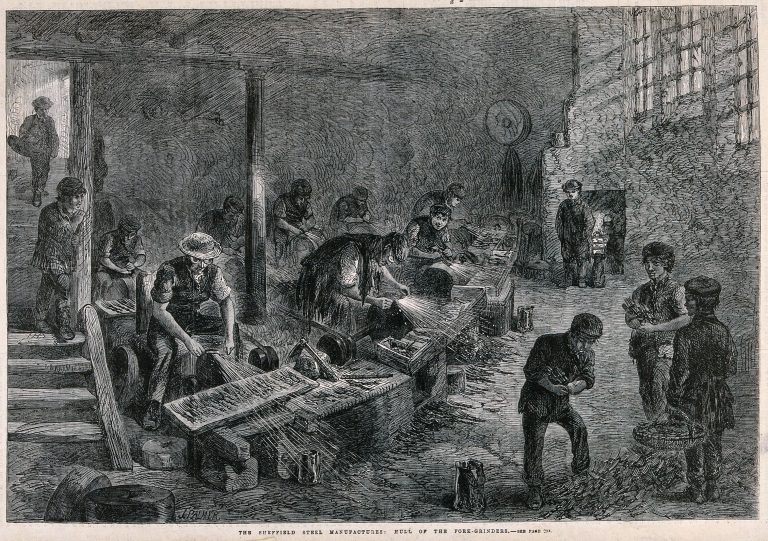
Image: Men and boys working in a fork-grinding factory in Sheffield. Wood engraving by M. Jackson after J. Palmer, 1866. Wellcome Collection. Source: Wellcome Collection.